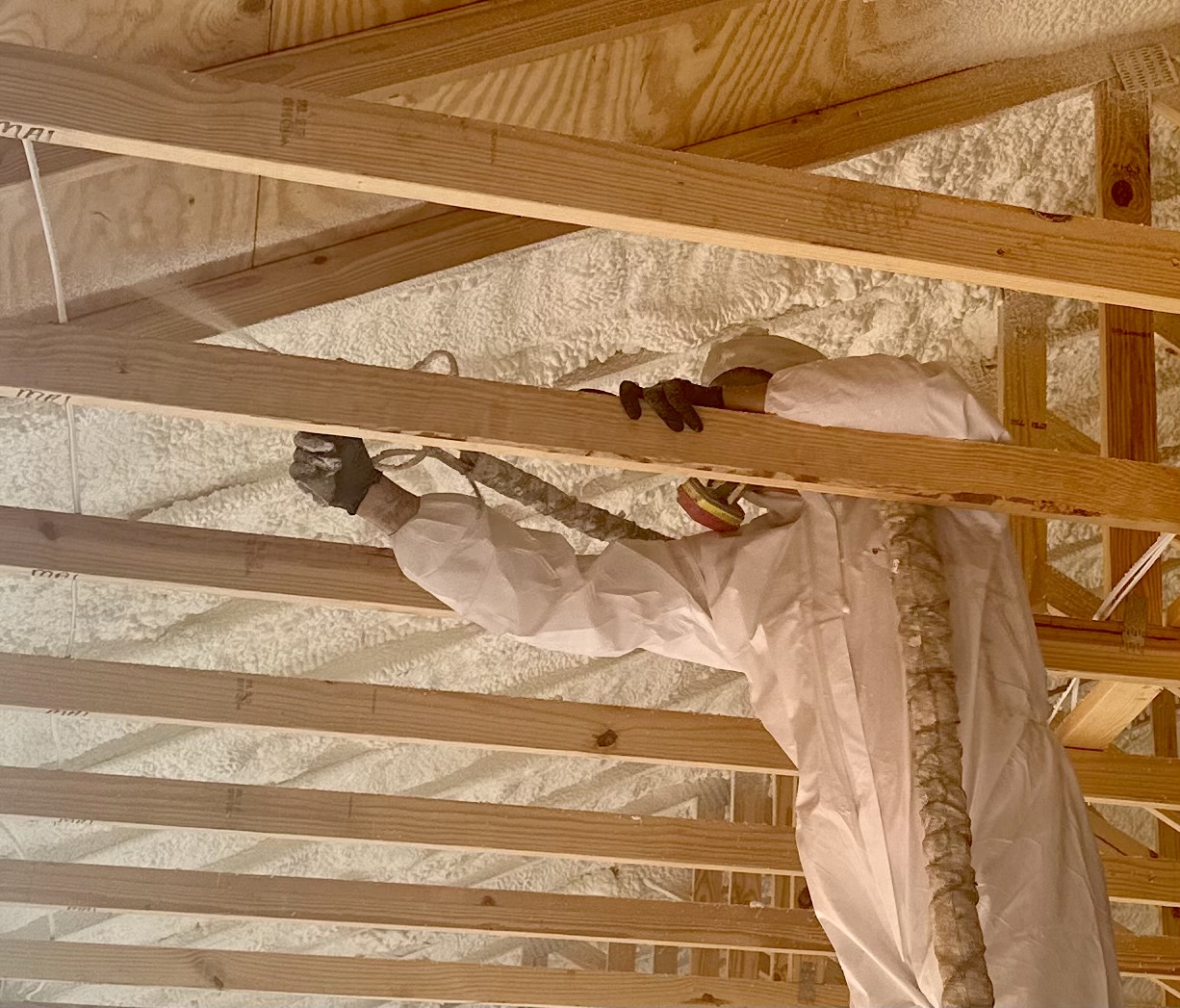
Bradenton’s housing peaked in the 1980s with the 1970s close behind — together 41 percent of the city’s homes, median build year 1983. Nearly 28 percent of residents are 65 or over. It is a town of long-tenured owners in ageing houses, which usually means the insulation in the attic is the insulation that came with it.
What we find in Bradenton
Pre-war frame, in the historic pockets
Around five percent of the city’s stock predates 1940 — the Village of the Arts with its 1920s architecture, Braden Castle Park with 192 historic buildings, and the fishing village of Cortez, settled in the 1880s by families from North Carolina. Wood frame, pier foundations, often no wall insulation at all and whatever was added to the attic decades later.
1950s through 1970s block
Bayshore Gardens is the archetype — platted in 1955, opened 1956, four hundred homes by 1958, mid-century modern models selling for eight to fifteen thousand dollars. Concrete block, shallow trussed roofs, cramped attic access, original insulation at R-11 to R-19 now settled well below that. These are the homes most likely to measure under FPL’s R-8 threshold and qualify for the rebate.
The 1980s peak
Block and wood truss, blown fibreglass to roughly R-19 or R-25, heavy condo and villa production. Original single-glazed aluminium windows on these are now forty years old and pitted by salt air.
Manufactured homes — roughly one in eight countywide
Manatee County holds around 31,000 mobile and manufactured homes. The failure modes are underneath — belly insulation sagging or gone, ducts running through that cavity, metal roofs with almost no depth above. The 55+ parks along the Bayshore corridor and out toward Ellenton and Palmetto are full of them, and most owners have never been told the work is even possible.
FPL rebates work differently here
This area is Florida Power & Light territory, and FPL’s insulation programme works on a completely different principle to Duke’s or TECO’s. Worth understanding before anyone quotes you.
- Ceiling insulation rebate: $220, applied as an instant credit on the contractor’s invoice.
- The qualifying test is your existing insulation, and the threshold is low. Your attic must measure less than R-8. That is the only R-value gate — FPL sets no minimum finished R-value.
- The home needs whole-house central electric heating and cooling, and an accessible attic — flat roofs and inaccessible attics are explicitly excluded.
- Work must be done by an FPL-approved Participating Independent Contractor.
- A/C upgrade rebate: $200 at SEER2 15.2 or above.
Under R-8 sounds harsh, but a great many pre-1990 attics around here genuinely measure that low once you push a ruler into the settled fibreglass. The way to find out is FPL’s free Home Energy Analysis — call 800-342-5375 and they will come and measure it.
Two honest notes. FPL has no window rebate and no current duct rebate, whatever older pages claim — for windows the money comes from My Safe Florida Home instead, which offers free wind-mitigation inspections and grants up to $10,000 covering impact windows and doors. And if your attic already measures better than R-8 you will not qualify, in which case we will tell you plainly whether the job still pays for itself on runtime alone.
Helene put water in these homes. Milton put it through the roof.
Two entirely different events, two different kinds of damage.
Helene, 26 September 2024. Peak water at Port Manatee reached 6.04 feet above MHHW, surpassing the previous record of 3.69 feet set during Idalia the year before. Rainfall was only two to four inches — this was surge. On Anna Maria Island, essentially every single-family home saw at least three to four feet of floodwater, and Bradenton Beach officials assessed the city as 90 to 95 percent destroyed.
Milton, 9 October 2024. Landfall at Siesta Key just to the south, Category 3. Manatee took gusts to 102 mph at the Sarasota-Bradenton airport and five to ten inches of rain, with an isolated maximum of 13.05 inches near Bradenton — but almost no surge, because the track pushed water out rather than in.
So Helene flooded homes from below and soaked wall cavities, floor systems and manufactured-home bellies with saltwater. Milton damaged roofs, soffits and windows and let wind-driven rain into attics with no flood line at all — which is the damage people miss, because nothing downstairs looks wrong.
In both cases the insulation is not salvageable. Saltwater-saturated material holds chlorides and never recovers its R-value; the EPA is explicit that porous materials wet more than 48 hours generally have to be discarded. Wet insulation in a closed cavity with 75 degree overnight lows does not dry. It composts.
Salt air, and eight months of cooling
August averages a 92 degree high here and summer overnight lows sit at 74 to 75, so the envelope never gets a meaningful break. Average highs stay at or above 83 from April through October — the air conditioning essentially never rests, which is where the entire economic case comes from. FPL’s own estimate is up to 15 percent off heating and cooling costs.
Bradenton sits on a tidal river behind barrier islands, and the closest neighbourhoods — Cortez, Perico, Palma Sola, west Bradenton — are a mile or two from open bay water. Salt aerosol accelerates corrosion of attic fasteners, duct straps, HVAC coils, window hardware and metal roof components. Corroded soffit and gable vents restrict airflow, which pushes attic temperatures higher still.
Where we work
Across Bradenton and Manatee County — Village of the Arts, Braden Castle Park, Cortez, Bayshore Gardens, Whitfield Estates, Midway, Washington Park, downtown and the Riverwalk, Old Manatee, Palma Sola, Samoset, Perico, Trailer Estates, Braden Woods, Tara, River Club, Rosedale and Heritage Harbour — plus Anna Maria Island, Holmes Beach, Bradenton Beach, Palmetto, Ellenton, Parrish and Lakewood Ranch.
We handle insulation removal after flood and storm damage, plus spray foam, blown-in insulation, energy-efficient windows and storm damage repair.