Dade City is not like the rest of Tampa Bay, and the difference is worth stating plainly: there is no utility rebate here. Withlacoochee River Electric Cooperative, which is headquartered in town, is a member-owned co-op rather than a regulated investor-owned utility, so it is not bound by the state efficiency rules that force Duke, TECO and FPL to fund insulation rebates. Anyone quoting you a Dade City rebate has not checked.
So why insulate at all here
Because the payback comes off your bill rather than out of a rebate cheque, and in this climate that is the larger number anyway. An attic upgrade in a house running air conditioning eight months a year pays for itself on runtime alone. We would rather tell you that honestly than invent an incentive.
Two warnings while we are on the subject. Several contractor sites still advertise a federal tax credit of thirty percent on insulation — that credit expired on 31 December 2025 and no longer applies to work done now. And if your address falls toward Zephyrhills or south-west Pasco you may be on Duke Energy rather than the co-op, in which case up to $800 on attic insulation and $800 on windows genuinely is available. Check your bill; it is the only reliable way to know.
What Dade City houses are like
The historic core
Church Street developed as a residential area in the 1880s, and the Church Street Historic District now holds thirty-four contributing buildings. The city maintains a municipal register with more than 150 individually listed properties. Around the 1909 Beaux-Arts courthouse the stock is wood-frame vernacular, Queen Anne, Craftsman bungalow and Colonial Revival — houses with no wall insulation, cramped attics and whatever loose fill someone added decades ago.
Post-war block
The familiar Florida pattern: concrete block on slab, wood trusses, uninsulated masonry walls, and attic insulation at R-11 to R-19 where the code now asks for far more. Later subdivisions like Abbey Glen, built between 2008 and 2015, are better but still have the air handler in the attic.
Rural and agricultural
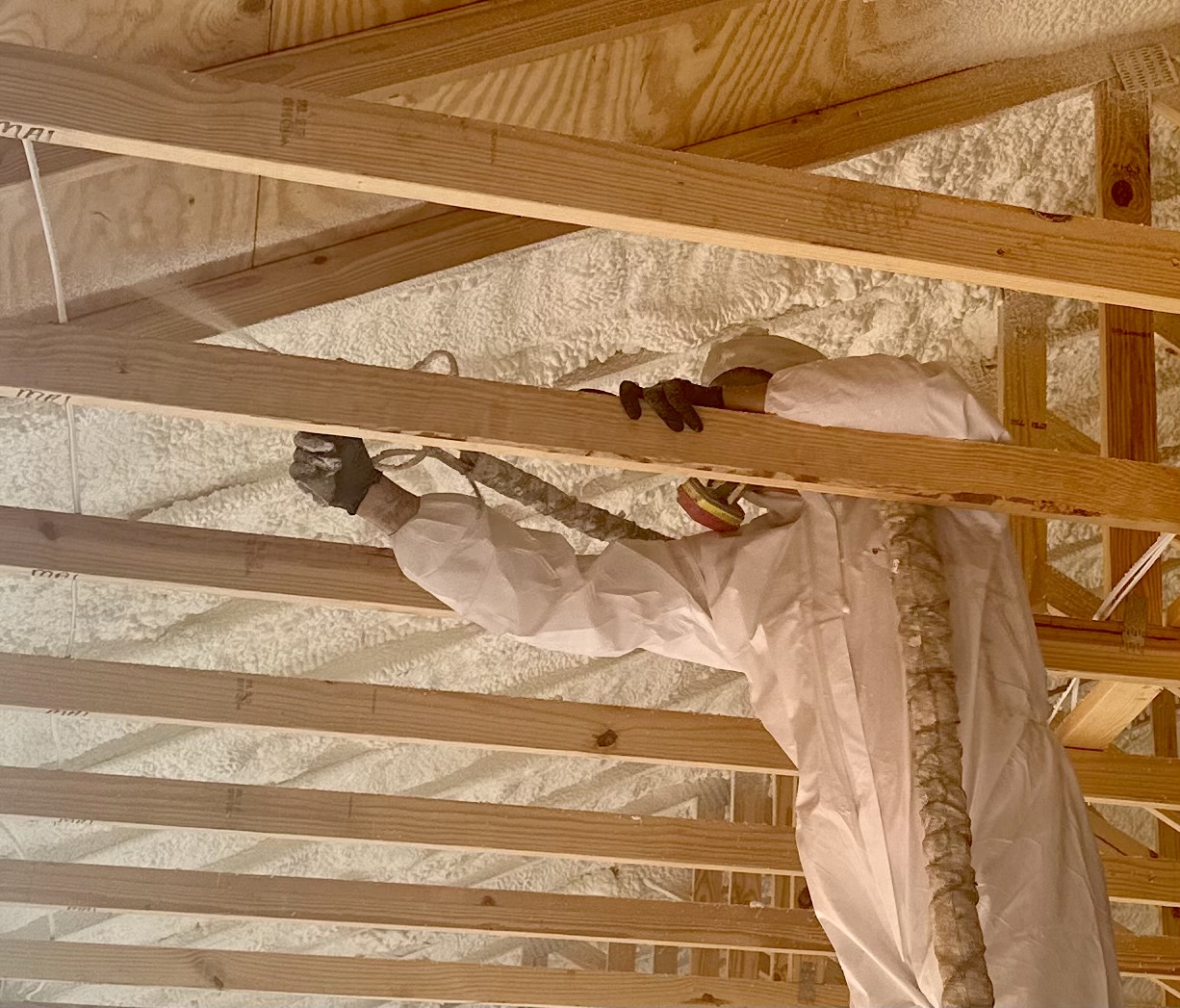
This is a large part of what we do out here. East Pasco — Lacoochee, Trilby, Blanton, Richland, St Joseph — runs heavily to manufactured homes, older farmhouses, workshops, pole barns and metal ag buildings. Closed-cell foam sprayed to the underside of a metal roof deck stops the condensation that otherwise drips onto whatever is stored underneath, and it is the single most useful thing we do in a barn.
One caution specific to older attics: vermiculite insulation, found in some pre-1990 homes, can contain asbestos. If we see it we stop and recommend testing before anything is disturbed. It changes the scope and the cost of a removal, and it is not something to guess about.
Hills, oaks and no storm surge
Dade City sits at about 118 feet with genuinely rolling terrain and mature oaks — nearby San Antonio and St Leo climb past 180. It is thirty-five to forty miles inland, so storm surge is not a factor. What does reach here is wind, wind-driven rain, tree fall and multi-day power outages; the co-op’s territory took heavy damage through the 2024 season with Debby, Helene and Milton in quick succession.
Inland does not mean exempt. A roof breached by wind lets rain into the attic, and wet insulation in Florida humidity does not dry — it compacts, loses its R-value for good, and grows mould. That is the most common reason we are called out here after a storm.
Where we work
Dade City and the surrounding east Pasco communities — the Church Street and downtown historic districts, Lake Jovita, Abbey Glen, Kumquat Landing, Mission Valley Estates, Hill Country Estates, Tara Oaks, Willow Run, Pasadena Ridge, plus San Antonio, St Leo, Lacoochee, Trilby and Blanton.
We install spray foam in homes, barns and metal buildings, fit blown-in insulation, and handle insulation removal after storm, water or rodent damage. We also fit energy-efficient windows and repair storm damage.