St. Petersburg is a bungalow city with a mid-century suburb wrapped around it, and since September 2024 it has also been a city with a serious wet-insulation problem. Both of those things shape what we do here.
What St. Pete houses need
The 1912 to 1945 boom — Kenwood, Old Northeast, Roser Park
Historic Kenwood alone holds 2,203 historic buildings, built mostly between 1912 and 1945, and bungalows are more than half of them. The Historic Old Northeast has 2,975. Roser Park, developed from 1910 along Booker Creek, adds 146.
These are wood-frame houses, often with no ceiling insulation at all or a thin degraded layer of original rock wool. Two specifics matter here. First, many still have knob-and-tube wiring, which a licensed electrician must certify de-energised before Duke will pay the insulation rebate — we build that step into the quote. Second, old attics sometimes contain vermiculite, which can carry asbestos; if we see it, we stop and recommend testing before anything is disturbed.
1945 to 1975 — the block era
Ranch and Minimal Traditional homes in concrete block on slab. The block walls have essentially no thermal resistance — they are thermally massive, which is not the same thing, and a lot of owners assume otherwise. The attic is the only realistic place to add R-value, and original levels of R-11 to R-19 sit squarely inside Duke’s rebate window.
1975 to 1999 — Shore Acres and the late build-out
Shore Acres was built mostly between 1970 and 1999. Block construction, attics commonly at R-19, ducts in the attic. Good candidates for a top-up plus duct sealing rather than a tear-out — unless they flooded, which many did.
Duke Energy rebates
Pinellas County is Duke Energy Florida territory, and Duke pays considerably better than the utilities inland. It also pays on windows, which most Florida utilities do not.
- Attic insulation: up to $800, applied as an instant credit on the contractor’s invoice rather than a rebate you claim afterwards.
- Energy-efficient windows: up to $800. The glazing has to meet a hot-climate specification, and the rebate applies to east, west and south-facing windows — not north-facing, and not sliding glass doors or French doors.
- Duct test and repair: up to $450, also instant.
- Heat pump water heater: up to $800. Total programme value runs to roughly $3,800.
The order matters and it is where people lose the money. You must complete a free Home Energy Check — online, by phone or as a full in-home visit — and receive a qualifying recommendation before the work starts. You then have 24 months to complete it, and the installer has to be a Duke-approved contractor. Renters are eligible too. Duke completed 2,820 of these checks in Pinellas County in 2025, so it is a well-used programme, not a technicality.
The attic rebate is tiered by how bad your existing insulation is, with the target being R-38 — which is also what the building code prescribes for new construction in this climate zone. If your attic already measures well, you will not qualify, and we would rather tell you that at the estimate than after.
Helene, and the insulation still sitting wet
On 26 September 2024, Helene drove a 6.31 foot surge at St. Petersburg, shattering the previous record of 3.97 feet set in 1985. Across Pinellas and Hillsborough, at least 18,500 structures took major damage. Twelve of Florida’s deaths from that storm were in Pinellas County. Shore Acres was among the worst affected — it has now flooded repeatedly, in Idalia in 2023 and again in Helene.
Two weeks later Milton arrived from a different angle. Because it made landfall to the south at Siesta Key, the surge actually blew out of Tampa Bay — but it dropped nearly nineteen inches of rain on St. Petersburg, over five inches of it in a single hour, and tore the roof off Tropicana Field.
Here is the part that still is not fixed in a lot of homes. Saltwater-saturated insulation does not recover. It compacts, loses R-value permanently, holds chlorides, and becomes a mould substrate. The EPA is explicit that porous materials wet for more than 48 hours generally have to be discarded, and that cleanup should happen inside 24 to 48 hours. Insulation left in a closed wall cavity in a city with 75 degree overnight lows does not dry — it composts. If your home took water in Helene and nobody opened the walls, that material is still there and still wrong.
One thing to establish before any repair: Pinellas County uses a 49 percent rule. If repair costs reach 49 percent or more of the structure’s value, the home is considered substantially damaged and must be brought up to current floodplain code. The county counts materials and labour including donated and owner-completed work. Get that assessed early.
Salt air and the moisture problem
St. Petersburg is a peninsula — Tampa Bay on one side, Boca Ciega Bay and the Gulf on the other, and almost nowhere in the city is far from salt water. Salt aerosol corrodes attic fasteners, roof flashing, drip edge, soffit vents and gable screening. Degraded vent hardware directly worsens attic temperature, so it is a performance issue rather than an appearance one. Aluminium window frames pit and their seals fail early, which is part of why the Duke window rebate is worth using here.
The moisture story runs the opposite way to the north. Hot humid outdoor air pushes moisture inward toward the cooled interior, so interior vapour barriers — standard practice in cold climates — are a defect here and can trap condensate inside the assembly. Kraft-faced batts installed by someone trained up north are a genuine failure mode in this market.
Where we work
Across St. Petersburg — Historic Kenwood, Historic Old Northeast, Roser Park, Snell Isle, Shore Acres, Downtown, the Grand Central District, Bayway Isles, Crescent Lake, Historic Uptown, Euclid St. Paul’s, Allendale Terrace, Greater Woodlawn, Pinellas Point, Lakewood Estates, Disston Heights, Coquina Key and Old Southeast.
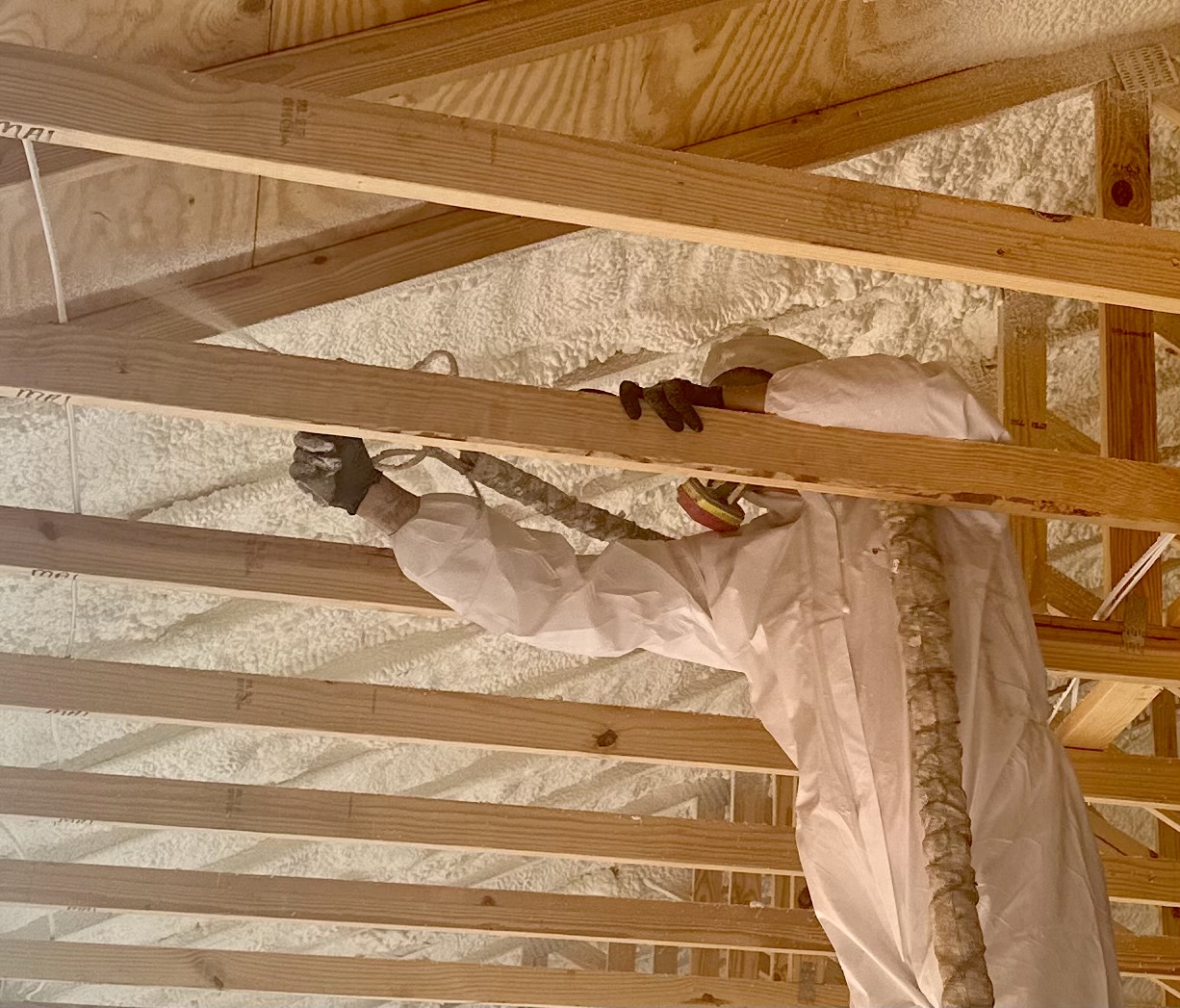
We handle insulation removal after flooding — the most common call here — plus spray foam, blown-in insulation, energy-efficient windows and storm damage repair.